


Those who know me well know that I am an inveterate infrastructure geek. This comes from the fifteen or so years I spent working in the critical infrastructure protection field earlier in my career. To this day, I can offer up esoteric facts about the behavior of commercial freight rail or refined petroleum logistics that are guaranteed to help a team win on trivia night.
As the field of spatial finance emerged and began to gain traction, the concept of stranded assets caught my eye. It was really more like a flame catches the eye of a moth. I could not stay away. I’ve written about it a couple of times over on my personal blog, and it’s always been lurking in the back of my mind as we’ve been building and maturing the Clairvoyint platform.
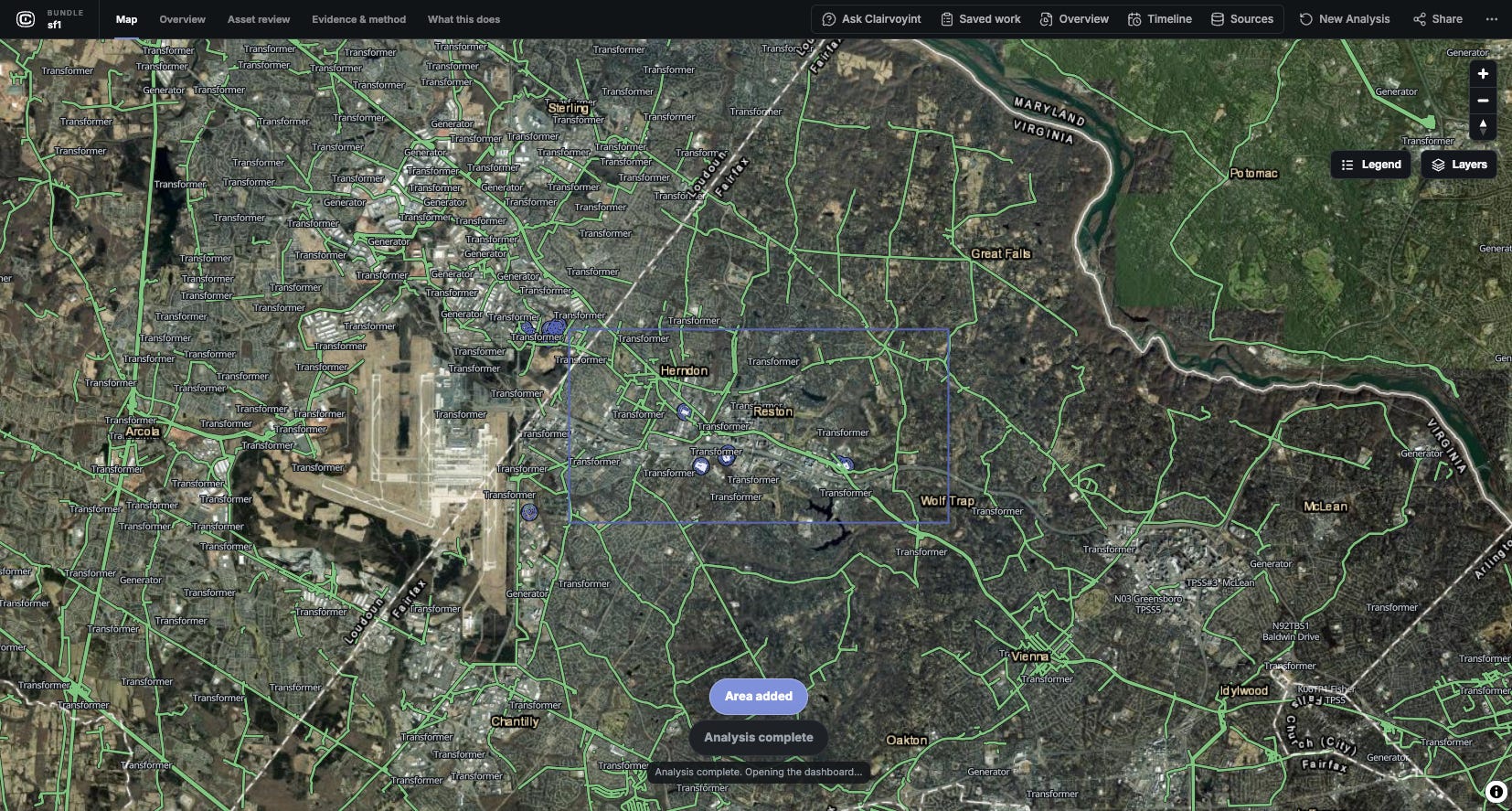
We are building Clairvoyint as a platform, with the intent of applying AI using neuro-symbolic patterns to accelerate methodology capture and automate advanced analytics. That’s a mouthful, but what does it mean? It means we see AI as a tool to help capture expertise the way experts think about it and then decompose it into repeatable analytics that may also use AI at appropriate points in the execution.
Notice that last sentence doesn’t say “make AI do everything.” When an expert sits down and thinks about their work, they’ll often identify the parts that are repeatable and build scripts or spreadsheets or similar tools to automate those parts. Then they’ll take those outputs, reason over them, and figure out what to do next. At Clairvoyint, we want our platform to do the same thing.
For any particular problem, we encapsulate the captured expertise into something called a Bundle. Over the last few weeks, we’ve built enough Bundles quickly to make me confident that Clairvoyint was ready to tackle my white whale of stranded asset susceptibility.
The Clairvoyint team has gotten used to, and maybe a little tired of, my “weekend projects.” Saturday morning, I sat down and began planning out the Bundle. The concept was to assess the susceptibility of data centers to becoming stranded assets as a result of infrastructure pressure. That means assessing the ability of supporting infrastructure such as power, water, and transportation to support the operations of the data center as it was originally designed. Or will pressure from new development impact operations over time such that the data center may need to be repriced or abandoned altogether?
Clairvoyint doesn’t attempt to answer that question, but does assemble and assess the information necessary for an informed analyst to do so. So what does this Bundle do? For a selected region, it pulls data centers from OpenStreetMap (OSM), supporting infrastructure from Overture, floodplain information from FEMA, and power generation and usage information from the EIA, and then performs analysis.
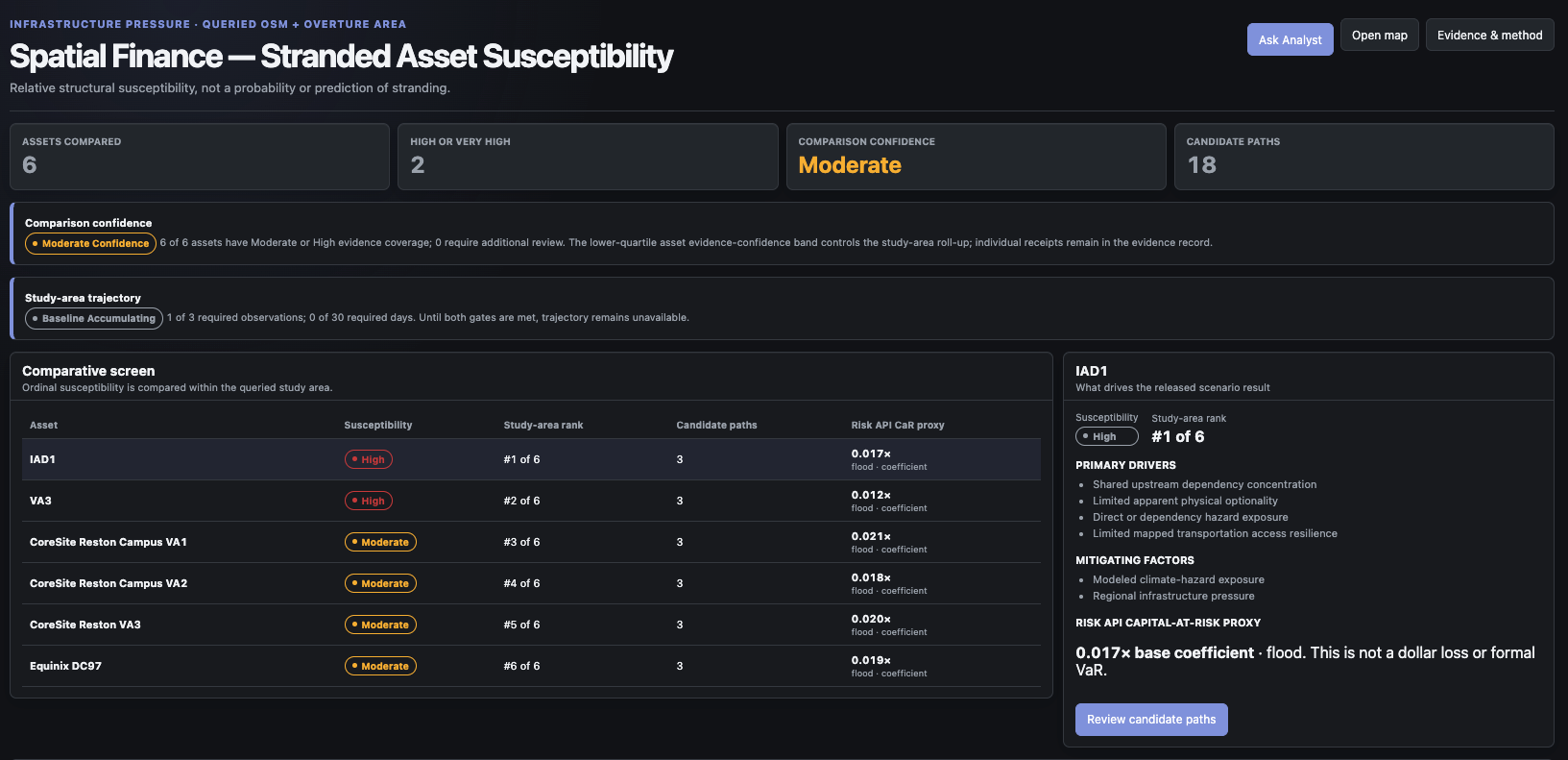
That analysis includes identifying supporting infrastructure assets via proximity, tracing upstream to identify concentration, assessing power generation trends, assessing floodplain positioning, performing climate risk scoring using Clairvoyint’s climate risk API primarily to assess heat and humidity, and determining a value-at-risk coefficient. It also pulls in OSM changesets over the region as a proxy for rate of development to project future infrastructure demand. Using that information, it develops a susceptibility rating for each data center.
There are some caveats. Proximity is not a great way to determine supporting infrastructure assets. As-builts often tell a different story, but once you establish the correct assets, the methodology is the same, so I feel comfortable using proximity as a proxy here. OSM changesets are not a reliable way to establish development trajectory because they are noisy. Someone could decide to focus on park benches. Someone else could map historical infrastructure that’s not actually there anymore. And so on. But establishing a process that says “here are things that weren’t there six months ago and the rate at which they’ve been added” is valuable, and changesets are a decent analog to get that working.
Because of those two caveats, I wouldn’t take any specific result to the bank quite yet, but I’m happy with the methodology underneath. I demoed this new Bundle to the team the following Monday afternoon. I’m excited about the trajectory we’re on with Clairvoyint. We’ve got a number of ambitious features in the pipeline, but the platform’s framework is already proving to be quite powerful and flexible.
We’ll be opening a beta in the next couple of weeks. We’re excited to get more real-world use cases to learn from, help us improve the platform, and begin adding value to important problems.