


The Wall Street Journal’s reporting on the relationship between Yemen’s Houthis and Somalia’s al-Shabaab highlights another layer of complexity for maritime shipping and the conflict in the Strait of Hormuz. The connection is indirect but strategically important: pressure at the Strait of Hormuz increases reliance on alternative export routes—and the Houthi–al-Shabaab network threatens one of those alternatives.
On the surface, they are unlikely partners. The Houthis are predominantly Shia Muslims, supported by Iran. Al-Shabaab is Sunni and the wealthiest al-Qaeda wing. They operate in different countries and have different local objectives. Historically, sectarian differences would have made cooperation difficult.
But terrorist organizations can be pragmatic. Al-Shabaab has money and wants better weapons and training. The Houthis have sophisticated weapons, technical expertise and an interest in extending their reach across the Gulf of Aden. Both consider the United States and Israel enemies.
Why a relationship in Somalia and Yemen matters to global markets
Yemen and Somalia face each other across the Gulf of Aden. Before the Iran war, roughly 12 percent of the world’s seaborne oil passed through those waters, according to the Journal.
With the Strait of Hormuz under pressure, the Gulf of Aden and the Red Sea become more important as an alternative route for oil leaving the Middle East. They also become more attractive targets.
The Houthis have already demonstrated that they can threaten commercial shipping with missiles and drones. Al-Shabaab brings money, fighters, territory and access to the African side of the waterway. The Journal reports that the Houthis have also sought al-Shabaab’s help placing radar in Somalia to monitor ships moving through the area.
Think about what that combination could mean. The Houthis gain another location from which to watch maritime traffic. Al-Shabaab gains weapons and technical knowledge it did not have before. Both groups gain options.
The immediate concern is an attack. The broader concern is the uncertainty the alliance creates for every organization that depends on those shipping routes. There is also an Iranian dimension. The Houthis are supported by Iran, so their ability to threaten shipping beyond Hormuz gives Tehran’s broader network additional leverage. Iran does not need to close every waterway itself if an aligned organization can raise the risk elsewhere.
A shipping company has to decide whether a vessel can transit safely. An insurer has to determine whether its existing assessment reflects the actual threat. An energy trader wants to know whether an incident is isolated or part of a developing campaign. A bank needs to understand whether a customer, vessel, import-export company or financial intermediary is connected to a sanctioned network.
Those decisions cannot be made by looking only at a map of recent attacks. They require an understanding of the people, capabilities, relationships and intentions behind them.
The network was taking shape in plain sight
An alliance like this does not appear overnight. It leaves indicators along the way.
There was a Somali intermediary moving repeatedly between Yemen and Somalia. There was a foreign-exchange business and an import-export company. There was a detailed weapons request. Front companies allegedly disguised shipments. Small boats moved military equipment across the Gulf. Fighters traveled abroad for specialized training. New drone knowledge moved into Somalia. A Houthi delegation later traveled to al-Shabaab territory. The Houthis expressed interest in maritime radar on the Somali coast.
Think of geopolitical risk as a weather system. It is not enough to know that a low-pressure system exists. You want to know where it is forming, whether it is strengthening, which direction it is moving, how fast it is traveling and what is likely to fall in its path.
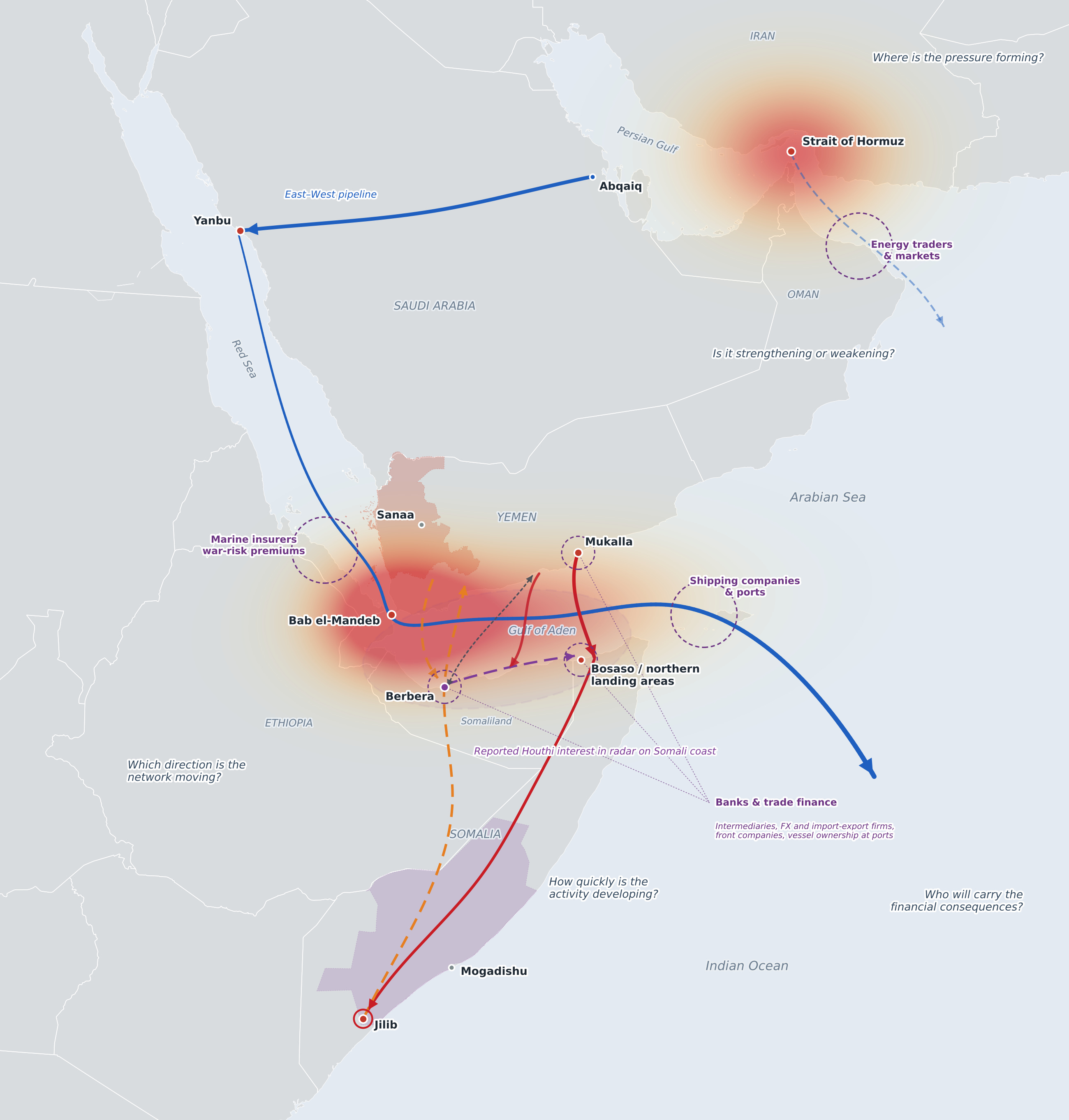
The map shows two related pressure points. The first is the Strait of Hormuz. The Houthi-al-Shabaab alliance is not operating there, but disruption at Hormuz makes alternative routes more important. Saudi Arabia can move some crude through its East-West pipeline to Yanbu on the Red Sea. From there, ships depend on the Bab el-Mandeb and Gulf of Aden - the waters between Yemen and Somalia where this network is developing.
That creates a second-chokepoint problem. The Houthis already have the ability to threaten commercial vessels from Yemen. Al-Shabaab could provide money, personnel, territory and access on the Somali side. Reported Houthi interest in maritime radar in Somalia raises another question: Is this still primarily a weapons-and-training relationship, or is it developing into a network that could monitor, select and eventually threaten maritime traffic from both sides of the Gulf?
Then there is the question decision-makers ultimately care about: What are the financial implications, and who carries the risk?
For a shipping company, that means identifying exposed vessels and routes and determining whether rerouting is becoming necessary. For an insurer, it means understanding whether the threat has changed enough to affect war-risk premiums or accumulation assumptions. An energy trader wants to know how much oil could be delayed or stranded and whether the market has priced that possibility. A bank needs to identify vessels, companies and financial intermediaries that may create sanctions or counterparty exposure.
That is what turns geopolitical reporting into decision intelligence. The question is no longer simply, “What happened?” It becomes: “What is forming, where is it headed, how quickly is it developing and who needs to make a decision before it arrives?”
Clairvoyint brings geospatial, maritime, economic and security information together while preserving where the information came from and how much confidence an analyst should place in it. A vessel anomaly, a new company, a weapons interdiction or a training movement may not mean much alone. Together, they may show that the operating environment has changed.
The objective is not to predict the date and location of one attack. Intelligence rarely provides that kind of certainty. The objective is to recognize a significant change early enough for someone to make a better decision.
Nada Bakos is the Chief Analytics Officer at Clairvoyint AI
See how Clairvoyint connects fragmented signals into decision-ready geopolitical intelligence.
Source and editorial notes
Primary source: Michael M. Phillips, The Wall Street Journal, “Washington’s Deadly New Headache: an al Qaeda-Houthi Terrorist Alliance,” August 31, 2026.
The article attributes information to U.S., Somali and Yemeni officials; intelligence assessments; an intelligence briefing; and regional security sources. Claims based on those materials are attributed in the post.
Supporting context: U.S. Department of the Treasury, “Treasury Sanctions Houthi Illicit Revenue and Procurement Networks,” September 11, 2025.